
Google Trends vs AI Search: How I Use Both for Content Research

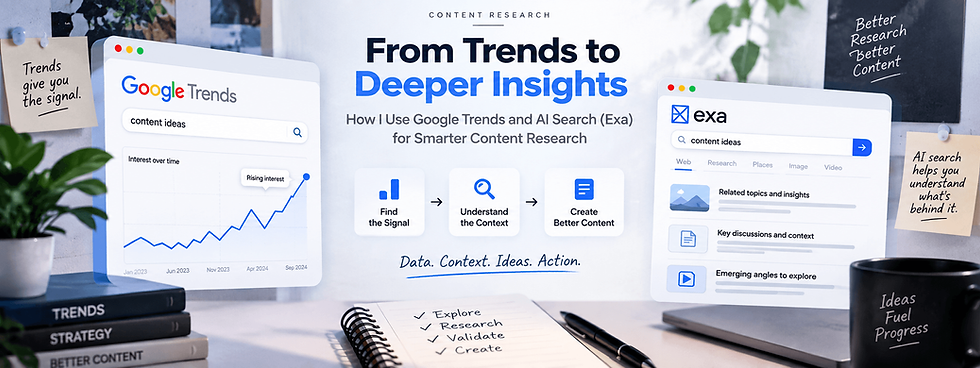
Finding a trend is only the beginning. The real question is what to do with it.
A rising search can give me a content idea, but the graph alone cannot tell me why the topic is gaining attention or what is happening around it. So, after testing Google Trends, I used Exa as an AI Search tool to investigate those topics further.
I focused on five areas: seasonality, short-term versus evergreen interest, search context, Breakout queries, and tool validation.
This helped me move from finding a signal to understanding the story behind it
What I Learned From Google Trends
In Part 1, I tested Google Trends through different content research examples, from comparing search terms and related searches to checking seasonality, spikes, categories, search types, and Breakout queries.
The main lesson was that Trends gives me a useful signal, but I still need to investigate what is happening around that signal before deciding what to create.
If you want to see how I tested these Google Trends features in practice, I covered the full process in Part 1: Why Google Trends Is Important for Content Research
That led me to my next step: AI Search with Exa.
Then I used Exa Agent Mode to do AI Search
After finding a signal, I wanted to investigate it from another angle.
So I used Exa to research five specific areas:
Seasonality and content planning
Short-term trends vs evergreen interest
Categories and different search types
Breakout queries
Using multiple tools to validate a trend
I didn't use Exa to replace Google Trends. I used it to ask better questions about what I found.
Here’s what I learned from each research area.
Seasonality Can Change When I Should Create Content
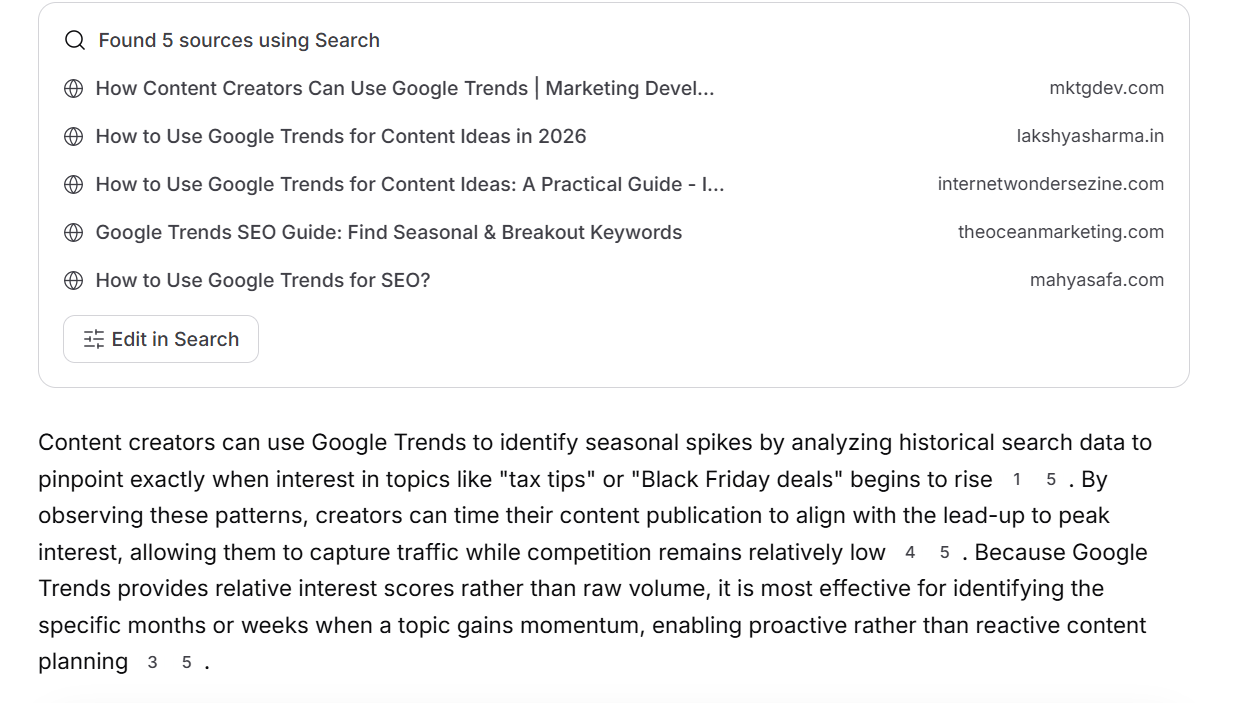
One of the first things I researched was how creators can use seasonal search behaviour to plan content.
The important point I took from this research was that timing matters. If interest in a topic follows a recurring pattern, I don't want to discover that pattern only after the peak has already happened. I can use the earlier signal to start researching the topic and prepare content before people reach that point.
This is also connected directly with my own “Black Friday deals” test from Part 1.
But AI Search gave me another step: instead of only seeing when interest changes, I could research what content could be useful around that period and what people may want to know when the interest rises.
That makes seasonality more useful for planning rather than simply observing a graph.
Not Every Spike Deserves the Same Content Strategy
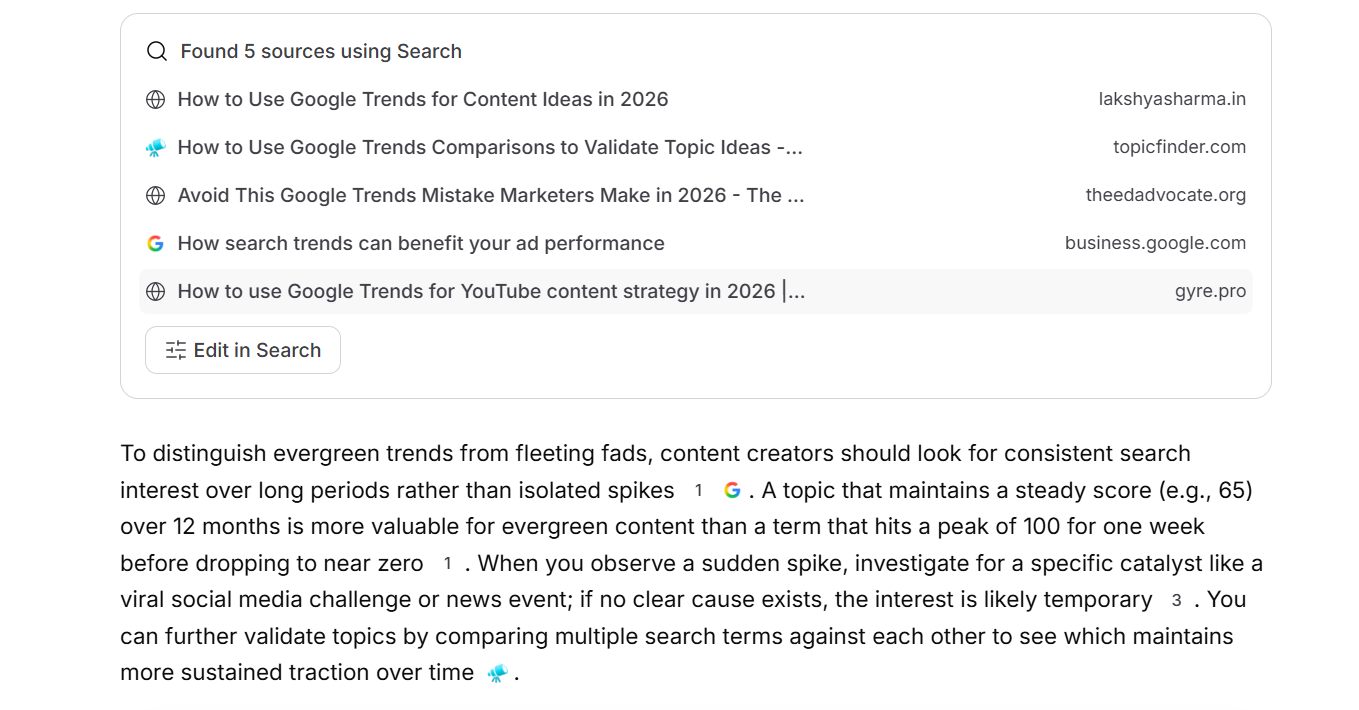
My second Exa search focused on the difference between short-term attention and long-term interest.
This was useful when comparing “Squid Game” vs. “how to cook.” A topic may suddenly rise because of a recent event, while another can stay useful much longer.
So, after seeing a rise, I should ask: “Why is this topic rising, and how long will the interest last?” For recent events, quick content can work because timing matters. For topics with lasting interest, I can focus on more evergreen content.
AI Search helped me understand these differences instead of treating every spike the same way.
The Same Search Can Have Different Context
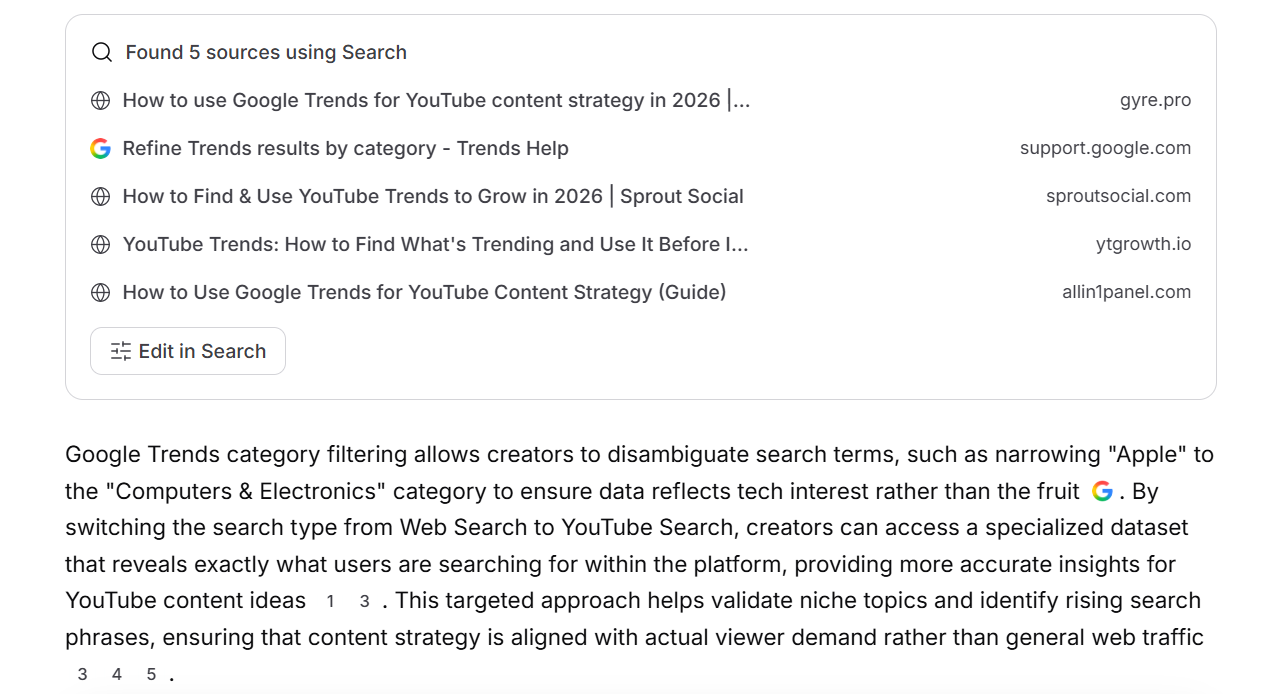
My third research focused on categories and search types. This connected with another test I had already done in Google Trends using “Apple.” The meaning of the search changes depending on the category.
I also compared “YouTube content ideas” across Web Search and YouTube Search and found that the interest pattern was not identical.
This showed me why I shouldn't look at a keyword alone. Before creating content, I wanted to understand what the search actually represents.
That is one area where AI Search becomes useful: I can investigate the topic, related questions, discussions, and context instead of treating the keyword as a complete picture.
A Breakout Query Is a Reason to Investigate
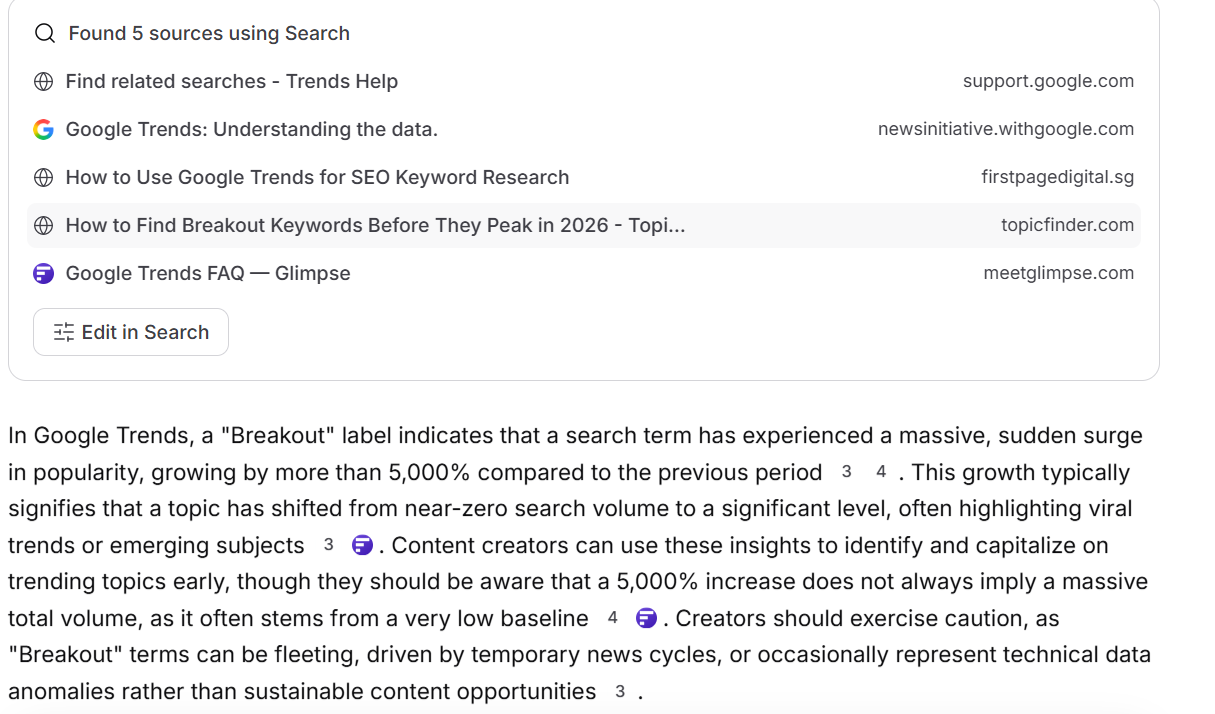
My fourth Exa search looked specifically at Breakout queries.
The thing I wanted to understand was not just what “Breakout” means, but what I should do after finding one.
A rapidly growing query can be worth investigating, but the growth itself doesn't tell me everything about the audience behind it. So I would treat a Breakout query as a starting point for research, not as an automatic reason to create content.
I can investigate what caused the growth, what the search is about, and whether I can find a useful content angle around it. That keeps me from making a decision based on one signal.
One Tool Doesn't Have to Answer Everything
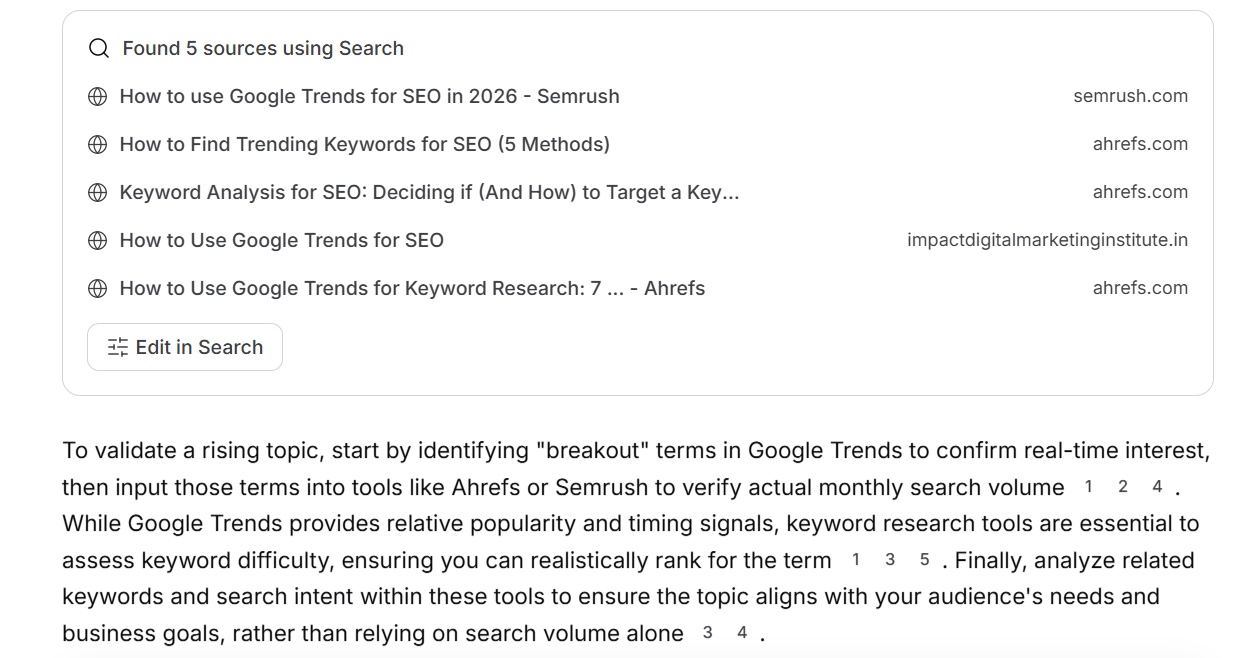
My final Exa research looked at how Google Trends can work alongside keyword research tools. This helped the complete process make more sense.
I can use Google Trends to spot a change, Exa to investigate the topic, and a keyword research tool to check search demand and competition.
Instead of asking “Which tool should I use?”, I started asking: “What question am I trying to answer?”
That became the biggest takeaway from the five searches.
Google Trends vs AI Search: How I Use Them
After working through the five Exa searches, I started looking at Google Trends and AI Search less as competing tools and more as different parts of the same research process.
Aspect | Google Trends | AI Search |
Search interest | Shows changes in search interest over time | Helps investigate the topic behind the search |
Trend discovery | Helps identify rising or seasonal interest | Helps explore what is happening around a topic |
Related information | Shows related searches | Helps explore related questions and information |
Context | Lets you filter by location, category, and search type | Helps investigate the broader context of a topic |
Research depth | Helps identify signals and patterns | Helps research and interpret those signals |
Content planning | Helps identify when a topic may be gaining interest | Helps understand what information or angles may be useful |
The two tools can therefore support different stages of the same research process
A Simple Workflow for Content Research
After working through the five Exa searches and my Google Trends tests, I can keep the process simple: Google Trends → Exa/AI Search → Keyword Research → Content
I start with Google Trends to spot a change, pattern, or topic worth investigating. Then, I use Exa to understand the context, explore what is happening, and identify areas for further research. Next, I do keyword research to identify search opportunities and relevant keyword information.
Finally, I use these findings to decide what content to create and which angle makes the most sense.
This process helps me move from simply noticing a trend to understanding it before creating content.
Where I Need to Be Careful
When I use these tools for content research, I keep a few things in mind:
Don't treat a single result as the full picture.
Check the context behind a sudden change.
Look beyond growth percentages when evaluating a Breakout query.
Use additional keyword data before deciding on a topic.
Verify important information before using it in the final content.
This keeps my research focused on understanding the signal rather than deciding based on a single result.
What Would You Use First for Content Research?
Which tool would you use first for content research?
📈 Google Trends — Find changing search interest
🤖 AI Search — Explore the topic and context
🔎 Both — Find the signal, then research it further
Vote and share your approach to content research.
Football Bros is a great example of how simple design can create addictive gameplay. You don't need huge graphics or complicated systems when the core experience of running, tackling, and scoring is already this entertaining.