
Designing the World's Best AI Video Generation Platform

Creating an AI video looks simple from outside. A user has an idea, writes a prompt, and gets a video.
But when someone actually tries to create a complete video, the process becomes much more complicated.
The real challenge is turning those clips into one complete, consistent video.
The Simple Idea vs. The Actual Reality
At first, AI video generation sounds incredibly simple.
You have an idea. You describe it. AI generates the video.
Idea → Prompt → Generate → Done.
That is what I expected too.
But when I started thinking about creating an actual video instead of just generating one impressive clip, the workflow started looking very different.
Suddenly, there were more questions:
What happens if the first clip is wrong?
How do I keep the same character in the next scene?
What if the camera angle changes completely?
How many times do I need to regenerate?
Where does the narration come from?
And after generating all these clips… how do they become one actual video?
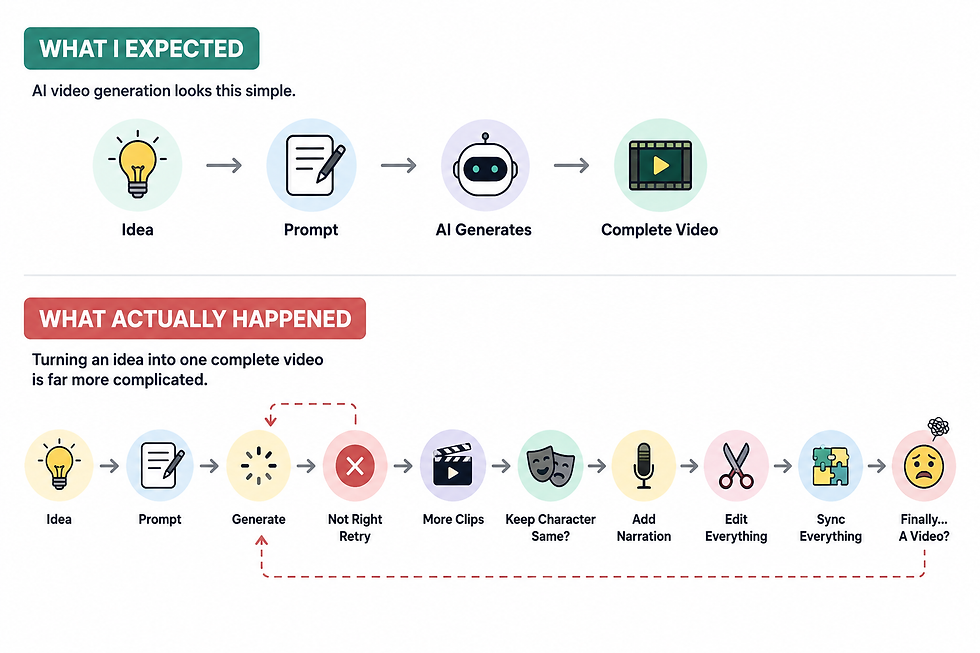
And that is where the real problem begins: creating a good clip is one thing, but creating a complete video is a completely different challenge.
The Workflow Is the Real Problem
One Video, Too Many Steps
Generating a clip was only the beginning.
Once I started thinking about the complete process, I realized that video creation was not happening in one place.
One tool might generate the visuals. Another might be better for narration. Then I might need an editor to join the clips, add music, adjust timing, and make everything work together.
So the workflow was no longer simply about generating a video. It became a process of moving between different tools and trying to connect everything together.
🎬 Generate visuals → 🎙️ Create narration → ✂️ Edit clips → 🎵 Add audio → 🔄 Sync everything
Somewhere in the middle, I realized I wasn't just creating a video anymore. I had become the project manager of five different AI tools.

Then the transition:
That made me think: what if the user didn't have to manage all these steps at all?
The Turning Point
“That made me think: What if the user didn't have to manage all these steps at all?”
The user has an idea.
“I want to create a video about…”
But behind that simple idea, there is a lot happening.
Scenes → What should happen?
Visuals → How should they look?
Narration → What should be said?
Editing → How do the clips connect?
Audio → Does everything match?
Then put the main realization in a highlighted/callout box:
💡 Maybe the user shouldn't have to manage each of these steps separately.
And then:
The idea I arrived at
User explains the video they want
↓
The system understands the goal
↓
The technical workflow is guided or handled in the background
↓
One complete video
The more I thought about it, the more I realized that an ideal AI video platform should not simply generate clips. It should help turn an idea into a complete video.
The AI Should Understand the Goal, Not Just the Prompt
User: Which tool should I use?
User: How do I write the prompt?
User: How do I connect these clips?
User: Why doesn't this scene match the previous one?
Imagine this:
User: “I want to create a short video about a man surviving in a snowy forest.”
And the system understands:
🎬 What scenes are needed
👤 Who the character is
🌲 What the environment should look like
🎙️ What narration is required
🔗 How everything should connect

The user should not have to explain every technical step separately. The system should understand the bigger goal and help break it down.
What Should an AI Video Generation Platform Do?
So if the user shouldn't have to manage every technical step, what should the platform actually do?
🧠 The user explains the idea
“I want to create a short video about…”
↓
🎬 The platform plans the video
Scenes, flow, and structure.
↓
🎭 It keeps things consistent
The same character, environment, and visual style across scenes.
↓
🎙️ It brings the pieces together
Visuals, narration, audio, timing, and editing.
↓
▶️ The result: one complete video
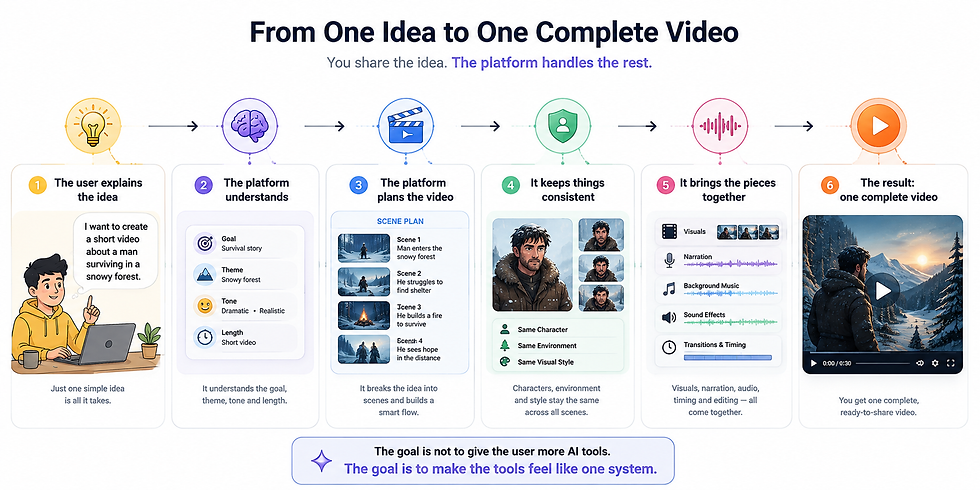
The goal is not to give the user more AI tools. The goal is to make the tools feel like one system.
The Platform Should Guide, Not Overwhelm
A beginner should not open the platform and feel like they need to become an AI expert first.
Start with a simple idea
Guide the user step by step when needed
Hide unnecessary technical complexity
Still allow more control for users who want it

Consistency Is What Turns Clips Into a Video
AI can generate individual clips. But a complete video needs those clips to feel like they belong together.
The same character across scenes
The same environment/style
A consistent voice/narration
Smooth connection from one scene to the next
The AI Should Handle Continuity in the Background
The user should not have to repeat the same instructions for every new scene.
Keep the character consistent.
Remember the visual style.
Understand what happened in the previous scene.
Help the story continue naturally.
The user focuses on the story. The AI keeps track of everything needed to make that story feel connected.
Everything Should Work as One System
A complete video involves more than generating visuals. Scenes, narration, audio, editing, timing, and continuity all need to work together.
The user explains the idea.
↓
The system understands the goal.
↓
It guides or handles the technical steps.
↓
The pieces come together as one complete video.
The goal is to make all these tools work together as one seamless system.
Final Thought
From an Idea to a Complete Video
Creating an impressive clip is already possible. The bigger challenge is turning multiple clips and creative steps into something that feels like one complete video.
That is what I believe a great AI video platform should do: let the user explain what they want, understand the bigger goal, and guide or handle the technical complexity in the background.
The user brings the idea. The platform helps turn it into a complete, consistent video.
Frequently Asked Questions
What makes AI video generation difficult?
Generating an individual clip is becoming easier. The bigger challenge is maintaining consistency and bringing visuals, narration, editing, audio, and timing together into one complete video.
Should users manage every technical step themselves?
Not necessarily. A good platform should understand the user's goal and guide or handle technical complexity in the background when possible.
Why is consistency important?
A complete video needs the same character, visual style, environment, narration, and a natural connection between scenes.
Does this mean the user loses control?
No. The platform should simplify the process while still allowing users to take more control when they want it.
Join the Conversation
Have you ever tried creating a complete video with AI? What was the hardest part of the process for you?


Comments