
I Tested 3 Open-Source I2V Models to Generate 3D Animation Video for Toddlers

At ALwrity, we’re continuously improving our YouTube Creator Studio to help you produce high-quality videos at the lowest possible cost. To find the best tools for toddler 3D animation, we tested three leading open-source image-to-video (I2V) models: LTX 2.3, Wan 2.2, and Hunyuan 1.5.
In this post, we share our hands-on test results, including the exact prompts we used, sample videos generated, and an honest review of each model. Whether you want to test these models independently or use them directly within the ALwrity platform, this guide will help you pick the right tool for your channel.

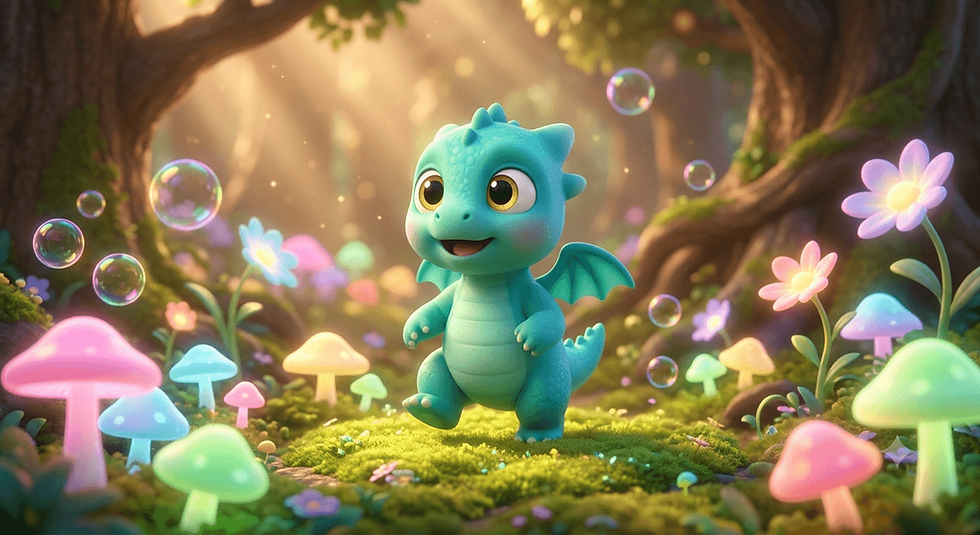
Prompt and Image that I used to generate a video using the I2V model.
Image:
Prompt:
Subject: The adorable baby turquoise dragon from the reference image, featuring smooth Pixar-style 3D geometry, plush-like soft textures, and vibrant toddler-friendly proportions.

Motion: The dragon gasps with wide-eyed wonder, takes two bouncy, wobbly footsteps forward, and executes a tiny, clumsy jump, flapping its miniature wings frantically before landing back down with a soft, joyful giggle.

Scene: A magical, enchanted forest clearing filled with oversized, neon-glowing pastel mushrooms, floating rainbow bubbles, and gently swaying fantasy flowers.

Shot Type: Full-body medium shot centered on the baby dragon, maintaining a toddler-eye level vantage point.

Camera Movement: Slow forward tracking dolly combined with a subtle upward tilt to dynamically follow the dragon's tiny jump while keeping the character perfectly framed.

Lighting: Warm, golden-hour sunlight filtering softly through tree leaves (god rays), mixed with gentle ambient glow emitted from the colorful mushrooms.

Style: 3D digital animation, Pixar and DreamWorks inspired aesthetics, ultra-clean surface rendering, soft subsurface scattering on skin, rich tactile materials, ray-traced reflections.

Atmosphere: Utterly charming, cozy, whimsical, safe, and full of playful toddler-friendly wonder.

Negative Prompt / Constraints: Hyper-realism, sharp edges, dark lighting, scary shadows, aggressive motion, rapid camera cuts, motion blur, distorted limbs, flicker, morphing artifacts, low quality, noise.
Model 1: Hunyuan 1.5
What Hunyuan Nailed (Strengths)
Subject & Character Consistency: The model did an excellent job retaining the original reference image's 3D character design. The smooth, Pixar-style geometry, toddler-friendly proportions, and soft textures remained intact throughout the video without losing character fidelity.
Key Motion Highlights: Hunyuan successfully captured several complex emotional and physical beats from the motion prompt:
The initial wide-eyed gasp was rendered naturally.
The frantically flapping miniature wings during the jump added great character detail.
The ending captured the joyful, soft giggle seamlessly.
Scene & Environmental Details: The surrounding enchanted forest environment was rendered faithfully, accurately incorporating the oversized neon-glowing pastel mushrooms, floating rainbow bubbles, and gently swaying fantasy flowers.
Lighting & Atmosphere: The lighting setup closely matched the vision—warm, golden-hour sunlight filtering through the canopy mixed with the subtle ambient glow of the magical mushrooms.
Style & Negative Constraint Adherence: It strictly adhered to the requested Pixar/DreamWorks 3D digital animation aesthetic. The output avoided dark shadows, aggressive movements, rapid cuts, or distracting morphing artifacts.
Where It Fell Short (Limitations)
Missed Footstep Sequence: While it captured the jump and wing-flapping, Hunyuan skipped the specific sequential footsteps—it failed to perform the two bouncy, wobbly forward steps before launching into the air. It jumped/bounced multiple times in the same place.
Lack of Dynamic Camera Motion: The prompt requested a slow forward tracking dolly paired with a subtle upward tilt to follow the character's movement. Instead, Hunyuan opted for a mostly static camera, relying solely on character movement within a fixed frame rather than executing the dynamic camera work.
Incomplete Jump Physics: The jump felt somewhat static or abrupt rather than a fully realized clumsy, bouncy arc with a distinct landing sequence.
Hunyuan 1.5 excels at visual fidelity, aesthetic polish, and emotional expressions (gasp, giggle, wing flap), making it fantastic for character aesthetics. And it struggles slightly with complex sequential footwork and precise dynamic camera tracking instructions.
Model 2: LTX - 2.3
What LTX 2.3 Nailed (Strengths)
Prompt & Visual Adherence: LTX 2.3 did a solid job capturing almost all core prompt instructions right out of the gate. The subject design, enchanted forest scene, shot framing, lighting, overall Pixar-inspired style, atmospheric tone, and negative prompt constraints were all properly maintained.
Micro-Expressions Captured: The model successfully executed the character’s micro-expressions as instructed, capturing the subtle emotional beats like the wide-eyed gasp and joyful giggle alongside the physical movement.
Forward Camera Movement: Unlike the Hunyuan 1.5 model that sticks to a static frame, LTX 2.3 successfully executed the dynamic forward tracking shot, continuously moving forward alongside the baby dragon to keep the action engaged.
Active Wing & Jump Motion: The model faithfully captured the energetic motion instructions, bringing the character to life with active wing-flapping and clear jump sequences.
Where It Fell Short (Limitations)
Repetitive Jump Loop: Instead of executing the specific prompt sequence—two wobbly steps followed by a single tiny, clumsy jump—LTX 2.3 got caught in a loop of jumping forward multiple times.
Lack of Vertical Camera Tilt: While the forward tracking motion was captured, the camera didn't execute the requested upward tilt to follow the peak height of the jump, staying on a mostly level path as it moved forward.
LTX 2.3 shines with dynamic camera movement, continuous motion, and rich micro-expressions, keeping pace with the character both physically and emotionally. Its main limitation is over-indexing on full-body action, leading to repeated jumps rather than a strict, step-by-step physical routine.
Model 3: Wan - 2.2
What Wan 2.2 Nailed (Strengths)
Exceptional Jump & Landing Physics: Wan 2.2 executed the main action sequence flawlessly—capturing the clumsy, bouncy jump and the smooth, soft landing with incredible natural physics.
Micro-Expressions & Character Detail: The facial micro-expressions were beautifully rendered, capturing the character’s emotional state during both the jump and the landing without any facial distortion.
Flawless Camera Tilt: Unlike the LTX 2.3 and Hunyuan 1.5, Wan 2.2 captured the exact camera movement requested: a precise, subtle upward tilt that dynamically tracked the dragon's jump height while keeping the character perfectly centered in the frame.
Full Aesthetic & Prompt Adherence: Subject design, scene elements, lighting (god rays and mushroom glow), Pixar/DreamWorks rendering style, cozy atmosphere, and negative constraint filters were all preserved with zero visual morphing or artifacts.
Where It Fell Short (Limitations)
Lack of Forward Locomotion: While the vertical jump physics were perfect, the model failed to execute forward movement. It did not take the two wobbly steps forward and landed back down in the same spot where it leaped, skipping the forward tracking dolly element of the motion.
Wan 2.2 delivers the highest precision in jump physics, character expressions, and dynamic vertical camera tracking. Its execution of the upward tilt as the dragon jumps is best-in-class. And it played it safe with horizontal spatial movement, sticking to a vertical jump on the spot rather than traveling forward through the scene.
Side-by-Side Comparison Matrix
Evaluation Criteria | Hunyuan 1.5 | LTX 2.3 | Wan 2.2 |
Cost | $0.10 (Cost-effective) | $0.10 (Cost-effective) | $0.15 (50% Higher Premium) |
Character Consistency | Excellent (Maintained smooth 3D geometry & plush texture) | Good (Preserved 3D Pixar aesthetic & character framing) | Excellent (Flawless rendering, zero distortion) |
Micro-Expressions | High (Captured gasp, wing flaps, and ending giggle) | High (Captured wide-eyed gasp & joyful giggle) | High (Precise facial expressions during jump & landing) |
Forward Locomotion | Missed (Skipped two wobbly steps before jump) | Over-indexed (Continuous, repeated forward jumping loop) | Failed (Jumped on spot, landed in original position) |
Vertical Jump Dynamics | Static (Failed forward tracking dolly & upward tilt) | Partial (Executed forward tracking, missed upward tilt) | Flawless (Perfect subtle upward tilt tracking peak jump height) |
Environment & Lighting | High (Captured god rays, glowing mushrooms & bubbles) | High (Accurately rendered scene details & warm lighting) | High (Fully rendered fantasy forest & ambient glow) |
Best Used For | Budget character showcases & emotional expressions | Fast action sequences with dynamic forward camera moves | High-precision vertical jumps & smooth camera dynamics |
Key Takeaways for Toddler 3D Animation Workflows
Best Budget Pick for Emotional Beats ($0.10): Hunyuan 1.5
Why: At the lowest tier cost on Wavespeed, Hunyuan 1.5 delivers fantastic character consistency and subtle facial micro-expressions (gasping, giggling). On the other hand, it requires a simpler motion prompt, as it struggles with complex dynamic camera work.
Best for Continuous Forward Action ($0.10): LTX 2.3
Why: Matching Hunyuan on price, LTX 2.3 stands out for keeping the camera moving forward with the subject. On the other hand, it got stuck in a repetitive jumping loop; it effectively maintained the forward tracking dolly shot while preserving key micro-expressions.
Best for Realistic Physics & Vertical Tracking ($0.15): Wan 2.2
Why: Despite the 50% price markup on Wavespeed, Wan 2.2 delivered superior motion physics. It accurately executed the upward camera tilt and smooth jump landing, making it the top choice for complex vertical character action (even though it missed forward ground travel).
What’s Your Go-To I2V Model?
Whether you are building a 3D toddler channel or experimenting with AI-assisted animation pipelines, combining these models based on scene requirements yields the best overall results.
Try It Yourself with ALwrity: Ready to test these models in your own production pipeline? You can start generating and optimizing your video prompts directly using ALwrity.
Drop a comment below: Which model performed best for your specific animation style—Wan 2.2’s physics, LTX 2.3’s tracking, or Hunyuan 1.5’s aesthetic polish?
Subscribe to our newsletter for more hands-on AI model benchmarks, prompt engineering guides, and creator workflows!
To learn more about what's cooking on our YouTube Video Creator Studio, read the blog below:


Comments